


Water Quality FAQ
Your water may look temporarily white or milky due to air bubbles, which can be caused by different temperatures of water entering the plumbing system. This should clear up on its own within a few minutes and is safe to drink.
Chlorine is used in the water treatment process to kill organisms that can cause disease. These levels may be adjusted during certain times to ensure the drinking water is disinfected. These levels are continuously monitored to ensure the water is safe to drink. To remove the taste or odour of chlorine, fill a container and let it stand overnight in the refrigerator.
A yellow or rusty discolouration can be caused by nearby construction or repairs to the water main. While the water is safe to drink, you can clear the pipes by turning the tap on cold until it runs clear.
Taste and odour may vary depending on the time of year. The water is constantly monitored and is safe to drink. However, if it is just one tap that produces water with a strange odour or taste, this may indicate a plumbing issue. Try running the cold water to flush the pipe.
We're glad you asked! You can check out our water treatment process to see each of the steps that help clean and safe water run through your taps.
If you have additional questions about your water quality, please call the Water Treatment Plant at 250-490-2560 or email at wtp@penticton.ca
PFAS in Penticton
PFAS stands for Per- and Polyfluoroalkyl Substances — a group of synthetic chemicals used in products like non-stick cookware, waterproof clothing, food packaging and firefighting foam. They’re often called “forever chemicals” because they don’t break down easily and can accumulate in the environment.
Why are PFAS a concern?
PFAS are persistent and widespread, found in water, soil, and even air. Some types have been linked to health issues such as:
- Increased risk of certain cancers
- Higher cholesterol levels
- Reduced immune system function
- Low birth weight
Growing scientific evidence shows that PFAS chemicals are linked to serious health problems.
Widespread PFAS contamination affects drinking-water systems across Canada. Municipalities are on the frontlines of dealing with ‘forever chemicals’ as they provide drinking and wastewater services to the community.
The City proactively monitors PFAS in drinking water, wastewater and compost. Testing since 2023 shows PFAS levels in Penticton’s drinking water are well below Health Canada’s recommended limits.
A recent report confirms:
- PFAS levels are well below Health Canada’s objective values.
- Continued monitoring is in place to ensure safety.
You can read more in the 2024 Water Treatment Plant Annual Report (starting on page 87).
Penticton’s drinking water comes from Okanagan Lake and Penticton Creek, treated at the City’s Water Treatment Plant before distribution.
Yes. Water from Okanagan Lake, Penticton Creek, and the Okanagan Channel has been tested, and PFAS concentrations are well below Health Canada’s limits.
Yes, but at very low levels:
- Wastewater levels are below Health Canada’s drinking water guidelines.
- Compost is well under the Canadian Food Inspection Agency’s limit for fertilizers.
The City of Penticton is:
- Proactively monitoring PFAS in water, wastewater and compost.
- Working with other governments to share data and best practices.
- Educating residents and visitors.
- Supporting provincial efforts, including legal action, to hold polluters accountable.
Monitoring will continue throughout 2025 and beyond to protect public health and the environment.
The City is aware of PFAS contamination at the Penticton Airport, which falls under the jurisdiction of Transport Canada. This contamination is linked to historical use of firefighting foam during training exercises.
While Transport Canada is leading the investigation, the City is:- Monitoring PFAS levels in its own systems.
- Confirming that all results remain below recommended limits.
- Supporting coordination with the Penticton Indian Band and other partners to better understand and manage PFAS risks in the region.
- Importantly, the airport is downstream of Penticton’s primary water sources, so it does not pose a direct threat to the City’s drinking water supply.
While PFAS are hard to avoid completely, you can reduce exposure by:
- Avoiding non-stick cookware made with PFAS.
- Choosing PFAS-free personal care and cleaning products.
- Limiting use of stain-resistant fabrics and carpets.
Here are a some helpful links.
- Read more in the 2024 Water Treatment Plant Annual Report (starting on page 87). View the 6-page summary here.
- Health Canada’s Water Talk: PFAS in Drinking Water
- Canadian Drinking Water Guidelines
The City of Penticton is joining the Province’s national class action lawsuit to hold manufacturers of perfluoroalkyl and polyfluoroalkyl substances (PFAS), commonly known as ‘forever chemicals,’ accountable for widespread public harm caused by drinking-water systems contamination.
In June 2024, B.C. filed a lawsuit against manufacturers of PFAS and PFAS-containing products, on behalf of provincial, territorial, and municipal governments responsible for providing water services to people in Canada.
Penticton is joining the class action to ensure the views of municipalities are included and provide evidence about how PFAS has affected local communities.
Water Restriction FAQ
Stage 1 Normal is in effect each year to ensure that the City of Penticton is prepared for warmer summer months and possible drought conditions. It helps to prepare us for a shift to higher water restriction stages if water levels decrease and drought conditions arise.
The Okanagan is very susceptible to drought, therefore, protecting our water sources is an important conservation strategy to protect our region against drought and heightened restriction stages.
Watering during the morning and evening reduces the amount of evaporation that occurs from the lawns, sprinklers and soil.
During the spring and summer season, the City closely monitors water use. Increased restrictions are typically triggered by sustained water consumption over the domestic water allowance combined with forecasts of increasing temperatures.
Stage 1 Restriction violation: not less than $25.00 for the first offence, $50.00 on the second offence, and if the offence is of continuing nature, a fine not less than $500.00 for each day the offence is continued.
Stage 2 Restriction violation: not less than $50.00 for the first offence, $100.00 on the second offence, and if the offence is of continuing nature, a fine not less than $500.00 for each day the offence is continued.
Stage 3 Restriction violation: not less than $100.00 for the first offence, $200.00 on the second offence, and if the offence is of continuing nature, a fine not less than $500.00 for each day the offence is continued.
Stage 4 Restriction violation: not less than $200.00 for the first offence, $400.00 on the second offence, and if the offence is of continuing nature, a fine not less than $500.00 for each day the offence is continued.
Hand-held watering and using drip irrigation for your vegetable garden can happen anytime.
Water restrictions do not apply to this until Stage 4 occurs, where it is prohibited. However, it is recommended that during Stage 2 and 3, that you restrict your water-use as much as possible in your vegetable gardens.
A person who has just placed new sod or planted a newly seeded lawn may apply to the Designated Officer to water outside of the use restrictions. The Designated Officer will consider the request and may give permission for the applicant to water outside of the use restrictions.
Please contact the Water Treatment Plant to request this.
Your lawn will naturally go dormant and turn brown during a hot, dry spell. A good rainfall or cooler weather will help your lawn revive quickly. Watering lawns sparingly or not at all during the summer months saves one household up to 17,000 litres.
During restrictions, parks and golf courses are watered using reclaimed wastewater through its irrigation system, which has been treated at the Wastewater Treatment Plant.
The City of Penticton uses these terms to describe water applications. They may be used interchangeably as terms to describe lawn watering but are commonly used in these applications:
"Irrigating": Refers to automatic and manual irrigation (to differentiate between automatic and manual, click here). During summer months, irrigation is restricted to alleviate stress on our water system to provide enough water for residents during the entire summer while ensuring emergency operations have the capacity to respond to fires.
"Sprinkling": Refers to automatic and manual irrigation (to differentiate between automatic and manual, click here).
"Watering": This term is typically used in water restriction communication and indicates lawn watering that has a restricted schedule. More specific wording will be used if needed (ie. "Hand watering": does not apply to Stage 1-3 restrictions, please refer here for definition).
Water Meter FAQ
Water meters are a proven way to conserve water, and have been shown to reduce water consumption by nearly 25%. Water meters are also a helpful tool to monitor your personal water use and detect leaks. By reducing the amount of water you use and detecting leaks quicker, this can help you save money on your utility bill.
City staff read the community's approximately 9,500 water meters, in conjunction with approximately 25,000 electrical meters, using an Automated Reader Reading (AMR) drive-by system. This is conducted monthly and takes about 20 hours to complete - equivalent to 1,700+ meters per hour. Previously, meters were read on foot, which took several weeks. The City of Penticton embraces the use of technology to create efficiencies in our work.

If your water bill seems high, here are some possible causes:
Irrigation: This is the most common cause of an increased water bill. A hole in your irrigation as small as 1.5 mm can cause dripping that leads to 280,129 litres lost over 3 months. A 6 mm hole can lead to almost 4.5 million litres lost over 3 months, which is the equivalent of 14,809 bathtubs full, or ~165 baths a day! To check for leaks, go here.
Landscape: Over-watering is a common source of high water use. Your lawn only needs 1 inch of water per week. Try stepping on your grass, if the blades spring back, you don't need to water!
Leaks: Check your toilets and faucets for leaks, as they often go unnoticed and can waste thousands of litres of water each month. Add a drop of food colouring in your toilet tank and wait a few minutes. If, without flushing, the colour appears in the bowl, you have a leak.
Visit our Water Meter page for an in depth explanation.
Water Conservation FAQ
Our lakes can be deceiving! Okanagan lake only fills 1.5 meters in an average year, which is further affected by evaporation. This causes water loss in an already water-stressed region.
In addition to this, the Okanagan has one of the highest rates of water use per person in Canada (mostly due to outdoor watering).
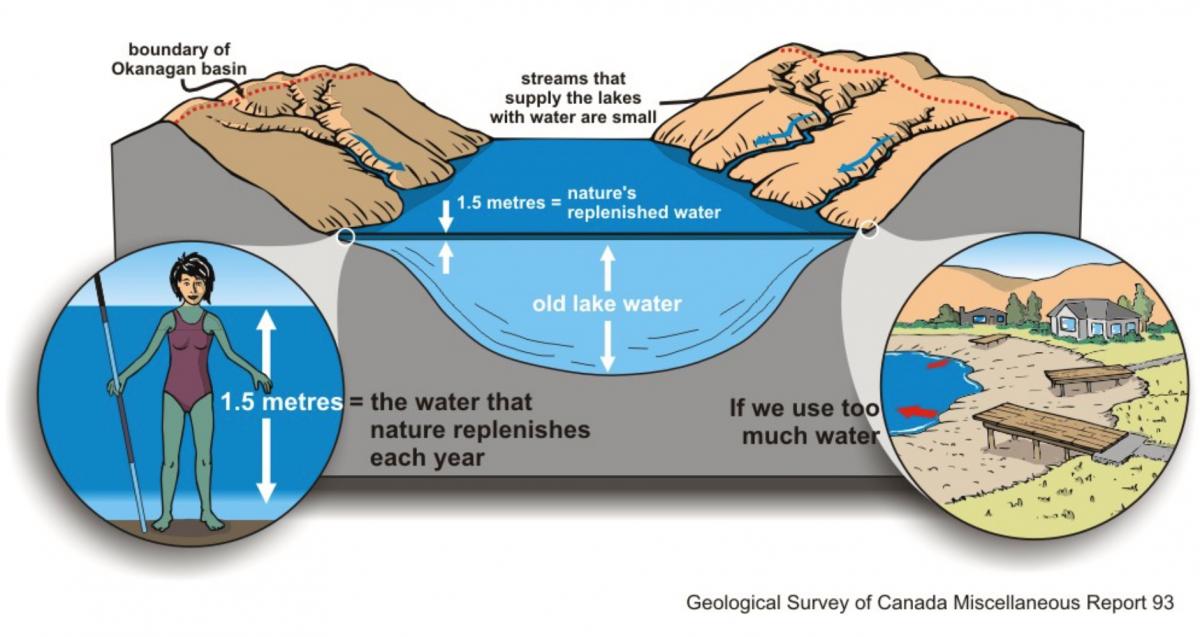
Research by the Okanagan Basin Water Board (OBWB), has determined how much water is used in our valley, and when. Residential outdoor water spikes in April when water is turned on for lawns and gardens, and continues until October.
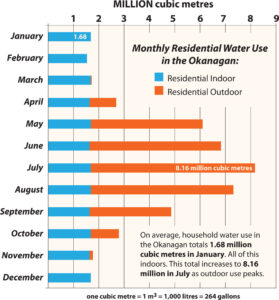
Agriculture, golf courses, and parks see spikes in mid-spring to mid-fall when outdoor watering begins.

For tips on both indoor and outdoor water conservation strategies, visit our water conservation page.
What about Beach Water Quality?
Each summer, our staff collects water samples from our beaches for Interior Health to test and analyze. Beaches are sampled weekly, with no fewer than five samples in a 30-day period.