

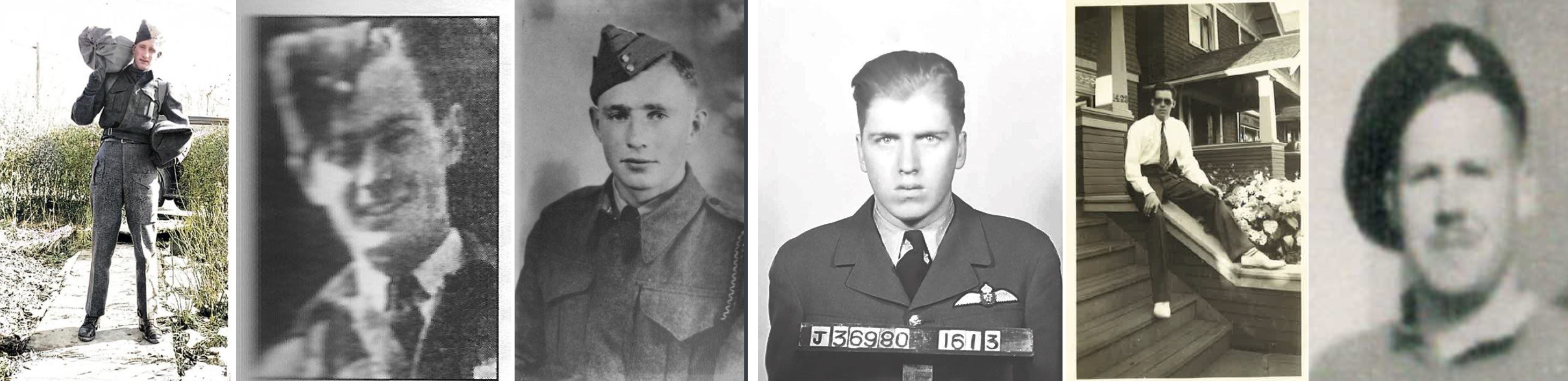
Our Remembrance Day street banners are now on display in downtown Penticton, paying tribute to those who gave their lives in the First and Second World Wars. They depict the images of 12 local servicemen, showing their ranks, unit names and photographs.
This includes six new banners, whose stories are being remembered, thanks to the manager/curator of the Penticton Museum & Archives. These men were all Penticton Secondary students at one time, all of whom who died while stationed overseas during the Second World War.
Next year, the City will also reveal a new painted crosswalk honouring our veterans.
We remember those who gave their lives. Lest we forget.
Ross Marshall Murray
1916-1943

Ross Murray came from a large family of five boys and three sisters. Although born in Saskatchewan, he spent most of his life in B.C., attending Penticton Secondary for two years. He worked as an apprentice printer at the Penticton Herald and later became a carpenter.
He enlisted in the Royal Canadian Air Force and trained at a number of air bases in Canada, finishing at a training unit in England. He eventually reached the rank of flight sergeant. During the Second World War, bomber crew members had the most dangerous job of all the armed services. The night skies over Germany were heavily defended with anti-aircraft fire (flak) and night fighters.
On the night of May 28, 1943, Ross and his four fellow crew members climbed into their Wellington bomber for a raid on the Ruhr Valley – an arms production region which supplied the German military with many of their heavy weapons. A total of 23 aircraft were lost, including Ross’s aircraft and crew. It’s not known how they were killed, and no record exists for their burial or the whereabouts of their bodies. Ross’s name is inscribed on the Runnymede Memorial, in Surrey, U.K., along with many other missing airmen.
Roy Vicars Atkinson
1922-1944

Roy Atkinson was born in Penticton in 1922. His parents were Reginald and Catherine Atkinson, with his father being the founder of the Penticton Museum and a First World War veteran. He attended local schools and finished his education at Pen High. Roy played football in high school and was described as an enthusiastic hunter and fisherman.
Roy joined the army in October 1942. He trained in Canada and arrived in England on July 28 to undergo further training. In November 1943, he was assigned to the 9th Canadian Armoured Regiment (British Columbia Dragoons). His rank was trooper, which, in an armoured regiment, is the equivalent of a private. He eventually qualified as a tank gunner and was shipped to the Italian front in November 1943 to begin active service.
On Aug. 31, 1944, the B.C. Dragoons took part in a major battle to break through German positions. They lost 51 men on that day, and, on the following day, Roy was killed.
Gregor Stephen Moore
1924 -1944

Gregor Moore was born in Penticton and attended Pen High, graduating in 1941. After leaving school, he worked for the Kettle Valley Railway as a car icer and locomotive watchman. He lived at the family home at 342 Rigsby Street with his mother. His brother, Warren, was serving in Italy with the Princess Patricia’s Canadian Light Infantry regiment.
Gregor joined the Royal Canadian Air Force on Step. 18, 1942 and underwent training and numerous locations throughout Canada. After he was posted to England, he was assigned to multi-engine training in an Airspeed Oxford.
On the night of April 27, 1944, Gregor and other trainees were practicing night flying. He was flying a circuit or pattern around his training base of Church-Lawton and was one of four aircraft in the air when a deadly intruder appeared. The German night fighter opened fire, hitting Gregor’s aircraft. The night fighter flew into the wreckage of the aircraft and crashed in turn, killing the pilot.
Leslie Frank Bull
1924-1944

Leslie Bull was born in Penticton and attended Pen High. He never graduated, leaving school at 17 to work. At the time of his enlistment, he was working as a farm labourer and orchard worker.
Leslie enlisted at age 17, with his initial interview describing him as having a “high learning ability, good appearance, willing and a good attitude.” It was noted he wanted to serve in the Royal Canadian Artillery, as his father had in the First World War. He trained at various locations in Canada and went overseas on May 26, 1944.
In Canadian historian Mark Zuehlke’s book, Terrible Victory, there is a passage that describes how Leslie died. Two fellow soldiers took him under their wing and mentored the rookie soldier. While attacking across a muddy field, they noticed he was lagging behind. One of the men took a heavy gun from him so he could keep up, but even so, Leslie fell behind. Just when the two men reached cover, they looked behind and saw Leslie fly into the air, the victim of an artillery shell.
John Meredith Routh
1916- 1945
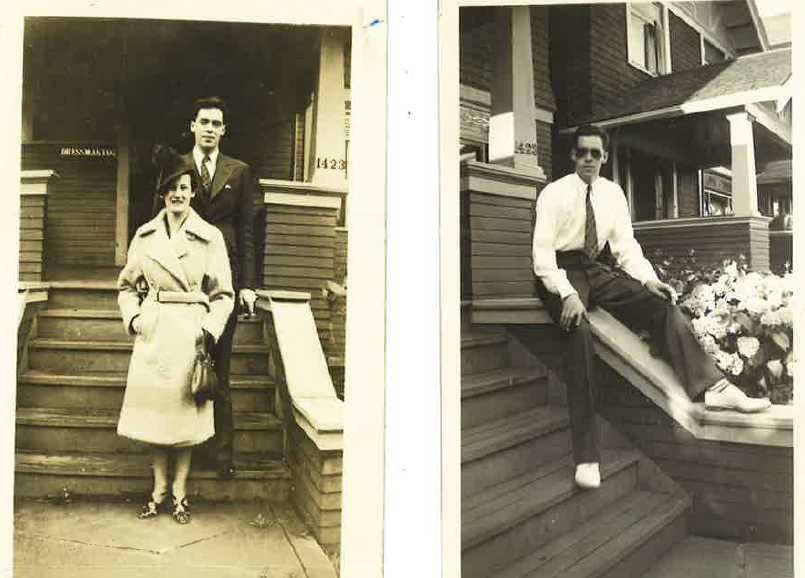
John Routh was born in Nelson in June 1916. He was one of three sons born to Albert and Cerrie Routh, who owned an orchard just outside of Penticton. He attended school in Penticton and worked as a mechanic for Greyhound Bus Lines. There are no records of him graduating from high school.
John joined the Royal Canadian Navy in August 1942 and received training at naval bases throughout Canada. In December 1944, he was posted to the 29th Motor Torpedo Bloat Flotilla (MTB), which was on active service in Europe. This was a group of eight motor torpedo boats stationed in England, whose job was to keep the English Channel free of enemy ships and submarines. These were small, fast ships armed with torpedoes, cannons and machine guns.
On the afternoon of Feb. 14, 1945, a number of boats were at anchor and preparing to go to sea. One of the boats was cleaning out a fuel tank and fuel was improperly drained into the harbour. It ignited and fire spread quickly among the boats, leaving little room to escape. The ships exploded and the harbour became an inferno. By the time the flames died down, 12 ships were completely lost and 61 sailors were dead. Johns body was never recovered; he is commemorated on the Halifax Memorial at Point Pleasant Park.
Gordon Sidney Finch
1918-1945

Gordon Finch was born in Penticton in 1918. He attended Pen High for two years but left school at the age of 17. He enlisted in the Canadian Active Service Force in 1940 and married three months later to Mary Kathleen Adams of Penticton.
At the time he joined the military, he was doing survey work and gave his occupation as a truck driver and bulldozer operator Given his experience, the military decided he would be a good fit for an armoured unit equipped with tanks – and he was posted to the British Columbia regiment. He was eventually promoted to Lance Corporal and earned a Good Conduct badge. Army authorities thought he would make a good officer and in 1943 he was posted to a training unit.
In December 1944, he was shipped to Europe as a reinforcement officer for the South Saskatchewan Regiment, an infantry unit. In February 1945 the Saskatchewans were involved in heavy fighting as part of Operation Blockbuster. This was part of a series of battles to secure the Rhineland area of Germany. Gordon was killed in action on the very first day of Blockbuster, on Feb. 26.
Leonard V. Adams
1895-1917
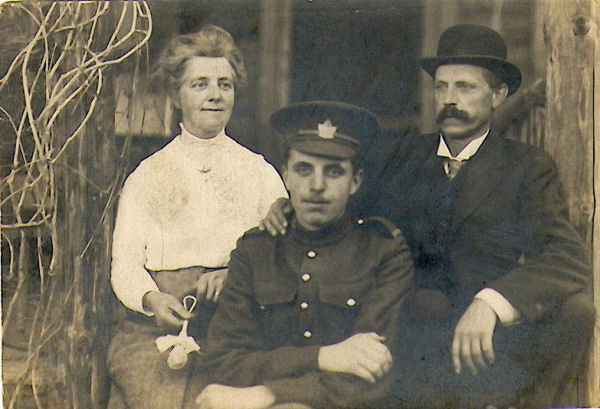
Leonard Adams was 20 years old when he enlisted in the Canadian Expeditionary Force. He was born in London, England and his family immigrated to Canada in 1909. He attended Pen High and, upon enlisting, gave his occupation as fruit grower.
Leonard joined the 2nd Canadian Mounted Rifles in January of 1916. This regiment was involved in intense fighting at the battles of Mount Sorrel and the Somme. In April, 1917, the 2nd CMR was sent to Vimy Ridge, where they were scheduled to attack on the morning of April 9th, 1917, along with all of the Canadian forces in France.
Leonard’s regiment was successful, but suffered heavily from German artillery fire as they were consolidating their positions. He was likely killed at this time, but in the confusion and stress of battle, no-one could be sure exactly when he died. Leonard is buried at the Canadian Commonwealth War Graves cemetery at Neuville St. Vaast, France.
“Leonard was very much liked for his sunny disposition and good comradeship and his loss to the community is greatly deplored." – Penticton Herald, May 10, 1917

James Esmond Clarke
1919-1944
James Esmond Clarke was the son of son of Esmond Gosnold Clark and Dorothy Clark, of Kaleden, British Columbia. He was a Lieutenant in the Royal Canadian Artillery. Clark was killed on August 8, 1944, during Operation Totalize, a Canadian Army offensive that was meant to break through the German lines in Normandy. He was 25 years old.
George Clifford DeBeck
1896-1917

George Debeck was an 18-year-old bank clerk when he enlisted in the Canadian Expeditionary Force in 1914. He came from a prominent Penticton family and was a graduate of Pen High, where he excelled in math and English.
Debeck initially served in the 15th battalion of the CEF, which was part of the 1st Canadian Division. At some point in 1915, he was shot in the thigh. Several months later, after he recovered from his wound, he accepted a commission (promotion to officer) and joined the British Army. At this time, the British were expanding their armies quickly, and a veteran like George would have been seen as a valuable addition to their ranks. It was while serving with his new regiment, the 23rd Royal Fusiliers, that George Debeck was killed on February 1, 1917. He would have been 21 years old.
Donald B. Hilliard
1921-1944
Donald Hilliard was the son of Wilmot and Ruthella Hilliard of Penticton. He joined the Royal Canadian Armoured Corps and was assigned to the Fort Garry Horse, a western Canadian armoured regiment. His rank was trooper, (equivalent to a private in an infantry regiment). He was killed on D-Day, June 6, 1944. He was one of 13 members of the Fort Garry Horse killed that day. Donald Hilliard was 21 years old.
Two others depicted in the banners include:
- Jack H. Sammet (Pilot Officer, Royal Canadian Air Force: 1921-1943)
- William J. Nesbit (2nd Lieutenant, 19th Squadron, Royal Air Force: 1895-1918)
We remember those who gave their lives in the service of Canada.
“They shall grow not old, as we that are left grow old; Age shall not weary them, nor the years condemn. At the going down of the sun and in the morning, We will remember them.” – The Ode of Remembrance (Robert Laurence Binyon)